Address
Right Bhusari Colony, Kothrud, Pune, Maharashtra
Work Hours
Flexible Working Hours
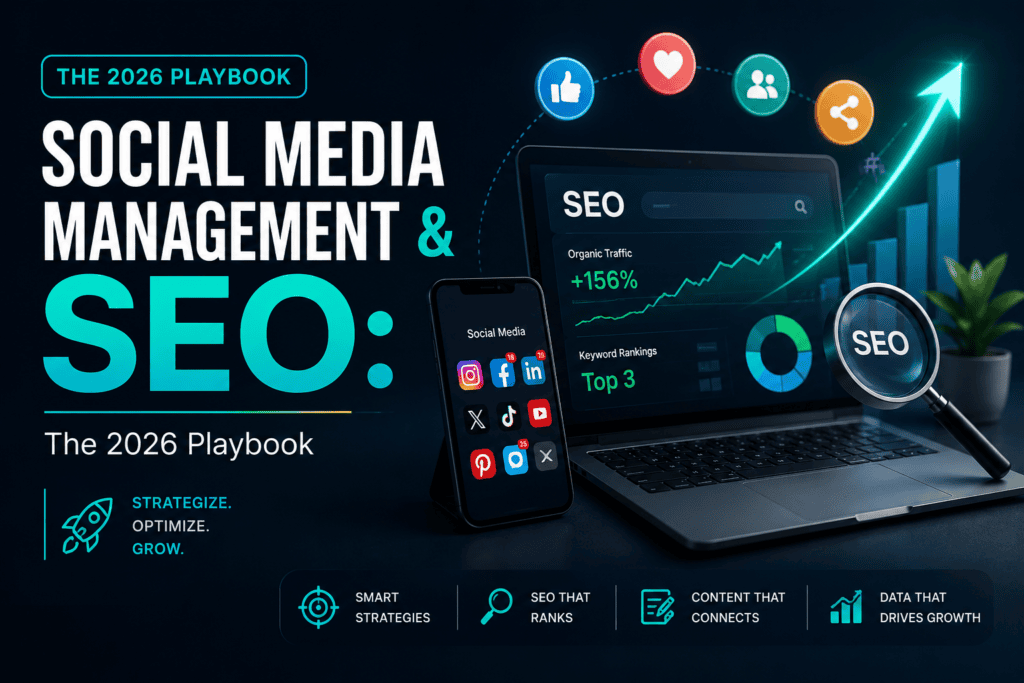
For years, brands treated Social Media Management (SMM) and Search Engine Optimization (SEO) as two separate departments with two separate goals. SEO chased rankings on Google. SMM chased engagement on Instagram, LinkedIn, and X. They rarely spoke to each other, and even more rarely shared a strategy document.
That separation no longer makes sense. Search engines have changed how they discover, rank, and reward content, and social platforms have quietly become search engines in their own right. If you’re still running SEO and SMM as isolated workstreams, you’re leaving visibility — and revenue — on the table.
This shift became impossible to ignore after Google’s May 2026 Core Update, which began rolling out on May 21, 2026 and finished on June 2, 2026. It was Google’s second broad core update of the year, following the March 2026 core update, and by most accounts it hit harder and faster than its predecessor. Understanding what that update rewarded — and what it punished — is the key to understanding why integrated SEO and social strategy is no longer optional.
Google described the update in familiar language: a regular, broad ranking adjustment “designed to better surface relevant, satisfying content for searchers from all types of sites.” But the effects were anything but routine. Industry trackers reported significant ranking volatility within 48 hours of the rollout starting, with further spikes over the following two weekends before the update fully settled on June 2.
A few patterns stood out clearly once the dust settled:
That last point matters enormously for anyone managing SEO or social content in 2026. Search is no longer a single query followed by ten blue links. It’s becoming a multi-step, conversational, sometimes autonomous process — and the content that wins in that environment looks very different from the keyword-stuffed pages that used to work a decade ago.
Search engines don’t just crawl your website anymore — they read the signals your brand generates everywhere. Here’s how social activity now directly and indirectly influences search visibility.
Search a brand name today, and you’ll typically see the company’s Instagram, LinkedIn, and X profiles occupying real estate on page one, sometimes above the brand’s own website. A dormant or inconsistent social presence is a missed ranking opportunity, not just a missed engagement opportunity.
With AI Mode now handling over a billion monthly queries, and with generative AI answers increasingly pulling from a wide range of sources — not just top-ranking web pages — brand mentions, reviews, and discussions on social platforms feed directly into how AI systems describe and recommend a brand. A product with strong, authentic social proof is more likely to be surfaced favorably in an AI-generated answer than one with none.
The May 2026 Core Update reaffirmed that Google continues to reward “first-hand, non-commodity” content — material that clearly reflects real experience and expertise. Social media is one of the most natural places to demonstrate that experience: behind-the-scenes video, founder commentary, customer testimonials, and community discussion all generate authentic signals that are difficult for AI-generated commodity content to fake.
Great content earns links, but only if people see it first. A well-optimized blog post that nobody shares on LinkedIn or X may never earn the backlinks that help it rank. Social distribution is often the spark that gets high-quality content in front of journalists, bloggers, and industry voices who eventually link to it.
A growing share of users — particularly younger audiences — begin product research on Instagram or TikTok rather than Google. SEO teams that ignore the language, hashtags, and questions circulating on social platforms are missing an entire layer of keyword and content-gap research.
Given all of this, here’s a practical framework for aligning the two disciplines rather than running them in silos.
Pull search queries from Google Search Console and Google Trends, but also pull trending hashtags, comment themes, and frequently asked questions from your social channels. Overlapping topics between the two sources are your highest-priority content opportunities — they signal demand in both search and social contexts simultaneously.
Instead of writing a blog post and separately brainstorming social captions, flip the process. Build one strong, experience-driven pillar piece — the kind of first-hand, well-researched content the May 2026 update rewarded — and then break it into a content calendar: a LinkedIn carousel, an Instagram Reel script, an X thread, and a handful of quote graphics. This approach maximizes the return on every research and writing hour while reinforcing E-E-A-T signals across every channel.
Treat your Instagram bio, LinkedIn company page, and X profile the way you’d treat a website’s meta description and title tag. Use clear, keyword-relevant language, consistent NAP (Name, Address, Phone) details for local businesses, and a direct link to your most important landing page — not just your homepage.
Embed genuine social posts, reviews, and user-generated content (UGC) directly on product and service pages. This reinforces trust for both human visitors and search algorithms, and it’s exactly the kind of “non-commodity” signal that survived — and even benefited from — the May 2026 Core Update.
One of the clearest lessons from brands that came through the May 2026 update well is patience paired with data discipline. Google itself recommends waiting at least a full week after a core update completes before drawing conclusions, since rankings remain unstable mid-rollout. The smarter response to a ranking dip is:
Bring SEO metrics (organic traffic, keyword rankings, click-through rate) and social metrics (engagement rate, reach, follower growth, social referral traffic) into a single reporting view. When both move together after a content push, you have strong evidence that your integrated strategy is working — and a much clearer story to tell stakeholders than two disconnected reports ever could.
Instagram and Facebook remain critical for visual storytelling and Google Business Profile-linked local SEO signals, particularly for retail and service businesses. Consistent posting, geo-tags, and UGC reposts all feed into local search visibility.
LinkedIn has become an underrated SEO asset for B2B brands. LinkedIn articles and posts are indexed by Google and frequently surface for branded and thought-leadership queries, making it a natural extension of a company blog.
X (formerly Twitter) continues to influence real-time and news-adjacent search results, particularly for trending topics, making it valuable for brands that want to capture “fresh content” ranking opportunities.
The direction of travel is unmistakable. Google is investing heavily in AI-mediated search — from AI Mode’s billion-plus monthly users to autonomous Search agents that can complete bookings and tasks on a user’s behalf — while its core ranking systems continue to reward the same fundamentals: genuine expertise, real experience, and content built for people rather than algorithms.
Social media management is no longer a separate lever from SEO; it’s one of the clearest ways to demonstrate those exact fundamentals at scale. Brands that keep building content in isolated silos will keep feeling core updates as unpredictable shocks. Brands that integrate their SEO and SMM strategies — sharing research, content, and social proof across both — will experience the same updates as validation of work they were already doing right.
The May 2026 Core Update wasn’t an outlier. It was a preview of where search is heading, and the brands prepared for it were the ones that had already stopped thinking of “SEO team” and “social team” as two different things.
