Address
Right Bhusari Colony, Kothrud, Pune, Maharashtra
Work Hours
Flexible Working Hours

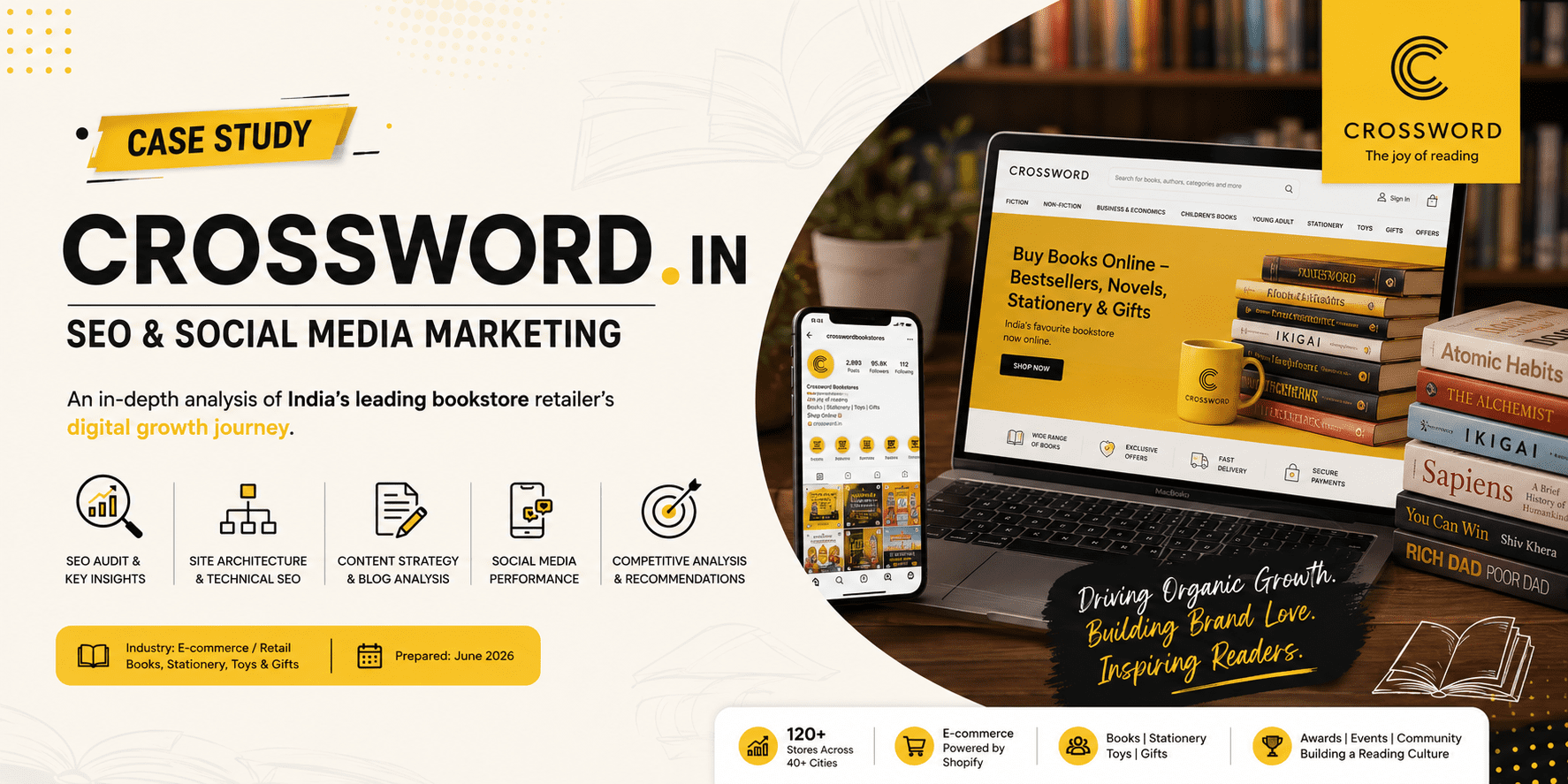
An analysis of India’s leading bookstore retailer’s digital presence — organic search positioning, on-site SEO architecture, content strategy, and social media engagement across platforms.
Prepared: June 2026
Industry: E-commerce / Retail — Books, Stationery, Toys & Gifts
Table of Contents…………………………………………………………………………………………….. 1
1. Company Overview………………………………………………………………………………………. 2
Key Business Facts………………………………………………………………………………………. 2
2. SEO Audit…………………………………………………………………………………………………… 2
2.1 Technical Foundation………………………………………………………………………………. 2
2.2 Site Architecture & Category Structure………………………………………………………. 3
2.3 Content & Blog Strategy…………………………………………………………………………… 3
2.4 Competitive SEO Landscape……………………………………………………………………. 3
2.5 SEO Recommendations…………………………………………………………………………… 3
3. Social Media Marketing Audit………………………………………………………………………… 4
3.1 Platform Presence…………………………………………………………………………………… 4
3.2 Strategy & Content Themes……………………………………………………………………… 4
3.3 Strengths……………………………………………………………………………………………….. 5
3.4 Gaps & Opportunities………………………………………………………………………………. 5
4. Competitive Snapshot…………………………………………………………………………………… 5
5. Summary & Strategic Takeaways………………………………………………………………….. 6
Crossword Bookstores was founded in 1992 in Mumbai and has grown into India’s leading bookstore retail chain, with over 120 stores across more than 40 cities, including its first international outlet in Dubai. The brand became a wholly owned subsidiary of Shoppers Stop in 2005 before being acquired by Agarwal Business House (ABH) in 2021, following a post-pandemic turnaround in which the new ownership refocused the brand on its book-first identity while leaning into social media to reach younger readers.
Crossword.in is the brand’s e-commerce arm, built on the Shopify platform, selling books, stationery, toys, and gifts to a pan-India audience. The website operates alongside the physical retail network and competes in a fragmented online book retail market that includes Amazon, Flipkart, BookChor, SapnaOnline, and several niche/regional booksellers.
| Attribute | Detail |
| Founded | 1992, Mumbai (Kemps Corner) |
| Current ownership | Agarwal Business House (ABH), since 2021 |
| Store footprint | 120+ stores, 40+ cities, plus a Dubai outlet |
| E-commerce platform | Shopify |
| Core categories | Books, Stationery, Toys, Gifts |
| Notable IP/programs | Crossword Book Awards, Crossword Kids Club, Book-A-Thon |
| Primary competitors | Amazon.in, Flipkart, BookChor, SapnaOnline, Oxford Bookstore |
The site is built on Shopify, which provides a generally solid technical SEO baseline: clean URL structures, automatic XML sitemaps, mobile responsiveness, and fast CDN-backed asset delivery. The homepage correctly implements core on-page elements:
One notable issue: the meta description and OG description use the word “Stationary” instead of “Stationery” in the page title — a spelling inconsistency that could mildly affect click-through quality and brand perception in search snippets, though it doesn’t block indexing.
Crossword.in’s navigation is unusually deep and well-segmented for a books retailer, which is a meaningful SEO asset. Top-level categories (Fiction, Non-Fiction, Business & Economics, Children’s Books, Young Adult, Stationery, Toys, Gifts) each break into 7–9 granular sub-collections, such as “Mystery & Thriller,” “Self-Help & Personal Growth,” or “Picture Books (0-2 Years).” This creates a large footprint of indexable, intent-matched collection pages — each one a potential landing page for long-tail searches like “thriller books online India” or “baby picture books online.”
The site also segments by author (Sudha Murty, Chetan Bhagat, Ankur Warikoo, Amish Tripathi, Ruskin Bond, J.K. Rowling) and by regional language (Hindi, Gujarati, Marathi, Tamil, Telugu), both of which target searches that competitors with thinner taxonomies may not capture as precisely.
Crossword runs an active blog (“From the Reading Desk”) publishing near-daily listicle and recommendation content — recent examples include “Best Murder Mystery Books Ranked by Readers in India,” “Psychological Thriller Novels That Will Keep You Up All Night,” and parenting/lifestyle-adjacent pieces like “Team Baby: Books to Read Together Before You Start Trying.” This format is well suited to capturing top-of-funnel, discovery-stage search queries and Pinterest-style social referral traffic, and each post links back into relevant product collections, supporting internal linking equity.
The cadence (multiple posts per week, per the June 2026 publish dates) suggests a dedicated content/SEO function is in place, which is a more consistent output than several competitors manage.
Crossword.in competes for organic visibility against a mix of horizontal marketplaces (Amazon.in, Flipkart) and book-specialist sites (BookChor, SapnaOnline, Kitabay, Bookswagon, MyPustak). Third-party analytics list crossword.in among the top-five most similar/competing sites to BookChor by traffic profile, placing it firmly in the specialist online bookstore tier rather than the marketplace tier.
Because Amazon and Flipkart dominate head terms (“buy books online,” “buy [title] online”) through sheer domain authority and inventory breadth, Crossword’s more realistic and winnable SEO opportunity is in branded search (“Crossword books,” “Crossword near me”), curated-list long-tail queries (where its blog targets), and store-locator/local SEO for its 120-plus physical locations — a hybrid digital-to-store advantage marketplaces cannot replicate.
| Platform | Handle | Notes |
| @crosswordbookstores | ~124K followers, 5,600+ posts — primary engagement channel | |
| Crosswordbookstores | Linked in site footer; long-running brand page | |
| Crossword Bookstores | ~7,600 followers; used for milestones, B2B/author news | |
| X (Twitter) | @crossword_book | Linked in site footer |
Instagram is clearly Crossword’s flagship social channel, both in follower count and posting volume (over 5,600 posts), and aligns with reporting that the brand’s post-2021 turnaround strategy explicitly leaned on platforms popular with younger readers to drive footfall and online sales. Recurring content pillars visible across channels include:
| Competitor | Positioning | Relative to Crossword |
| Amazon.in / Flipkart | Horizontal marketplace, vast catalogue | Out-competes on price & SKU breadth; Crossword competes on curation, brand, and store network |
| BookChor | Discount/used books specialist | Lower price positioning; Crossword differentiates on new releases, premium stationery, and retail experience |
| SapnaOnline | Academic-origin bookstore, strong in South India | Crossword has broader lifestyle/gifting range and stronger pan-India retail footprint |
| Oxford Bookstore | Premium, fewer locations | Crossword has far greater scale (120+ vs. a handful of stores) and e-commerce investment |
Crossword.in occupies a credible middle position in Indian online book retail: it cannot out-scale Amazon or Flipkart on catalogue depth or price, but it has built real differentiation through deep, intent-matched category architecture, an active blog/content engine, regional-language and author-based segmentation, and — most distinctively — a social media strategy that consistently bridges digital content with its 120-plus physical stores and live literary events.
The most leverageable near-term opportunities are largely about consolidation and measurement rather than new investment: fixing minor on-page SEO inconsistencies, adding structured data for local and product rich results, formalizing a short-form video and Pinterest presence to match existing content strengths, and tightening social-to-commerce attribution. Done well, these changes would compound an already differentiated content and community strategy rather than require Crossword to compete head-on with marketplace giants on their own terms.